
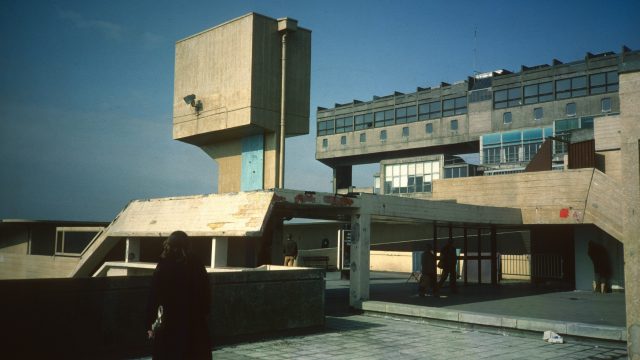
Cumbernauld was internationally famous during the 1960s for its innovative planning and architecture. The town was designated in 1955, becoming Scotland’s third post-war new town (after East Kilbride and Glenrothes). The initial aim was to take population from Glasgow, after studies in the early 1950s confirmed that there simply was not space to rehouse everyone then living in substandard housing within the city boundaries.
From the outset, the goal at Cumbernauld was to learn from the experience of the new towns that had been begun in the 1940s. Rather than the dispersed neighbourhoods of East Kilbride and Glenrothes, the planners wanted the town centre to be a single focus for the whole town, and for it to be within easy walking distance of the majority of the houses. Much use was made of terraced houses, often complex in form and layout, and often opening off paved walkways. The aim was a sense of ‘urbanity’. The planners, like a number of influential architects and writers at this time, believed that the low densities of earlier new towns like East Kilbride meant that these places did not feel very ‘urban’: they wanted Cumbernauld to feel like a town, rather than a suburb.
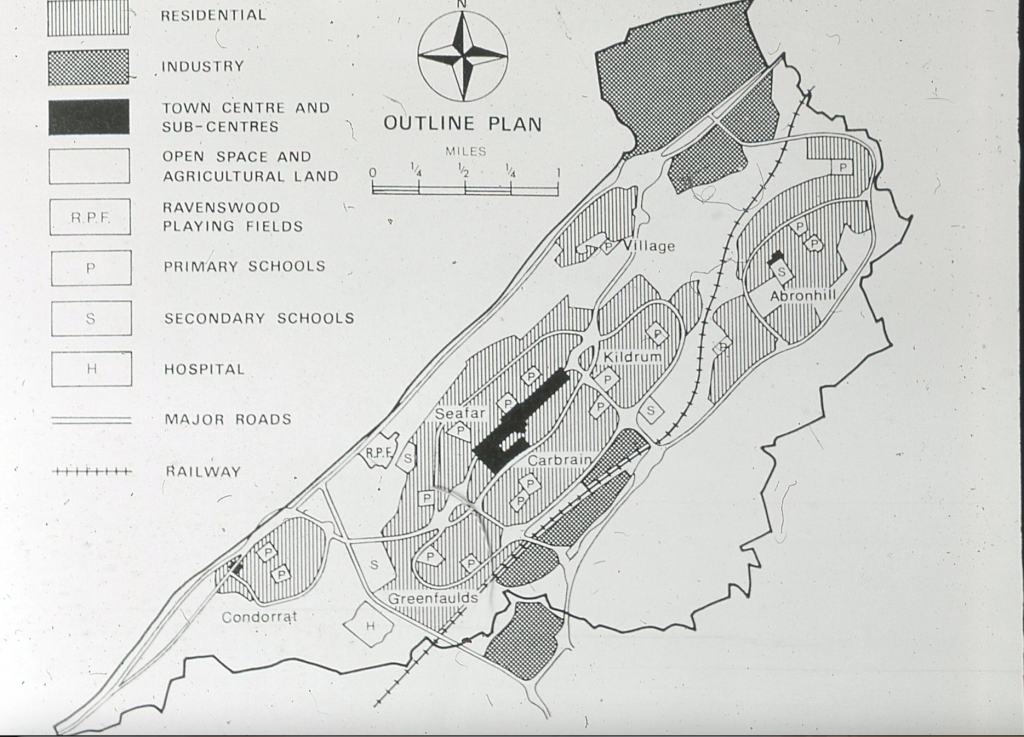
Between the tightly-knit housing areas, large roads (often with multi-level junctions) were threaded. In this respect, Cumbernauld was one of the first post-war plans really to come to terms with the growing number of cars on the road – something which began to increase rapidly in the late 1950s. For the first time, 100% car ownership was planned for. A separate network of pedestrian footpaths was planned to keep people away from cars in the interests of safety (and to avoid slowing traffic down).

Particular attention was given to landscape: the planners understood the whole town as a kind of landscape. Hard paving, including reused Glasgow setts, was adopted in the areas around housing, but there was also extensive provision of green space and, as in other new towns, works of art.


At the centre of Cumbernauld was its most celebrated feature (and now, perhaps, its most controversial moment). The town centre was planned as a single ‘megastructure’: a continuous, complex building form containing all the functions of the town centre. Parking and deliveries were organised at ground level. Above, a pedestrian deck housed shops in enclosed malls. Further up were such things as the library and a number of penthouse flats. Pedestrian ramps led out from the shopping malls into the surrounding housing areas. The ambition of the design attracted international attention, and awards. It was presented as an attempt to rethink the idea of a town centre for the twentieth century (perhaps even the twenty-first century). Only the first two phases were built as planned, however, with later additions including a more conventional shopping mall and a number of freestanding arranged around open car parks.
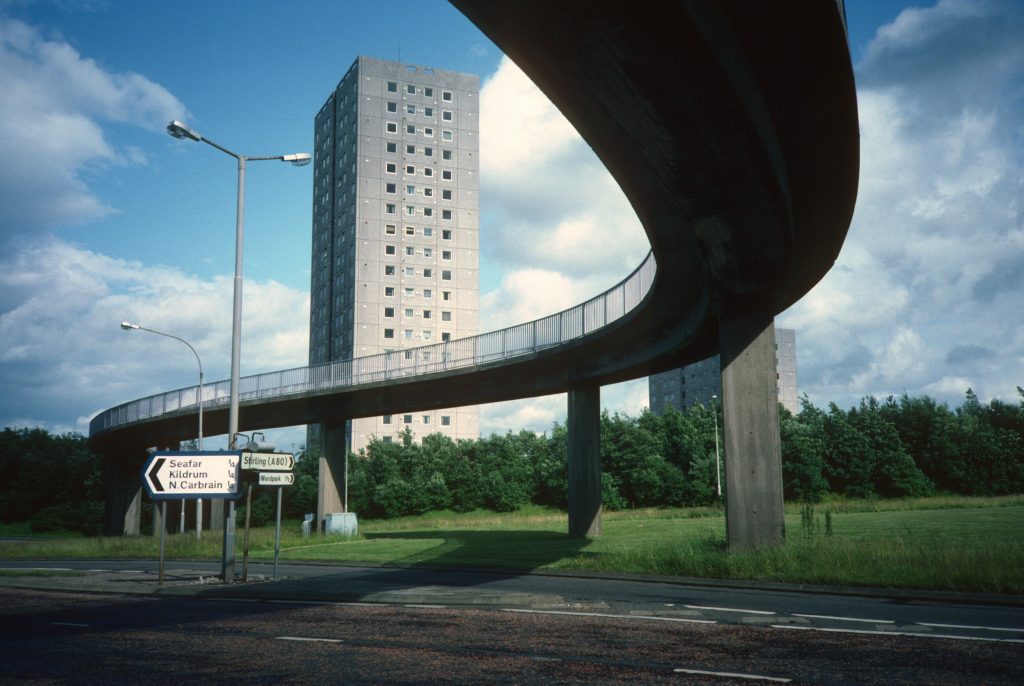
The population targets for Cumbernauld were increased in the early 1970s, and later phases of development have taken place to the west of the area developed in the 1960s. The 1960s town centre structure has been partly demolished; what remains attracts a mixed reception from residents and others. ‘Heritage’ designations in the town have favoured its stunning churches rather than housing or the town centre.


All of these images are from a guided walking tour as part of a ‘Towerblock’ and ‘Scotland’s Urban Past’ led by Jean O’Reilly on 24 September 2016 © Valerie Wright
Cumbernauld Development Corporation actively marketed the town to attract inward investment. See Tom Clarke’s brilliant thread on twitter of the town’s unique promotional film ‘Cumbernauld Hit’ from 1977
https://twitter.com/visuals0und/status/1326979117393342469
Our project is now complete and you can read more about our findings in our Open Access book. You are still welcome to get in touch with Dr Alistair Fair via https://www.eca.ed.ac.uk/profile/dr-alistair-fair If you have any questions about the project or media requests.
See our Privacy Statement relating to comments here – https://newtownsscotland.eca.ed.ac.uk/privacy-cookies/