
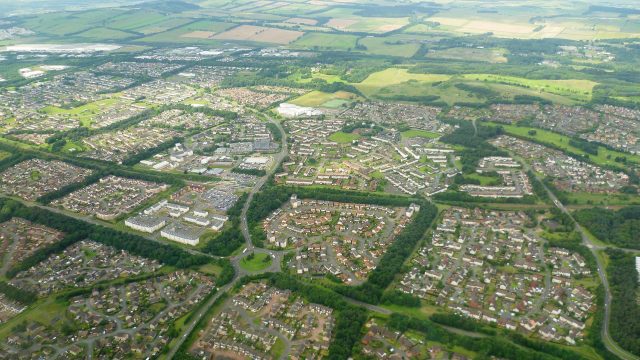
Livingston was one of a new wave of new towns designated in the early 1960s across England, Scotland, and Northern Ireland. The government and planners were reacting to forecasts which predicted significant increases in the population by the end of the century, while there was also growing emphasis on the idea that new towns could play an important role in supporting economic expansion. They would be ‘growth points’ where new industries and jobs would choose to locate. As had been the case for East Kilbride and Cumbernauld, it was also intended that Livingston would receive ‘overspill’ population from Glasgow: some 80% of the planned 70,000 residents were to come from the city. Within this context, the designation as a new town of Livingston was accompanied by a wider regional survey which saw the town as part of a broader chain of settlements between Edinburgh and Glasgow.
The plan was overseen by the landscape architect Peter Daniel. Like the plan for Cumbernauld, it took account of the rapidly growing number of cars on the roads, with a grid system of major roads. ‘Flexibility’ was also an important influence on the plans, and here Livingston broke new ground compared with the earlier new towns in Scotland. The planners recognised that the actual development of the town over many decades could not be entirely predicted, and so the grid system was intended as a framework which could be adapted over time. Within the grid, residential areas were planned as discrete entities. The town centre was located in the valley of the River Almond.
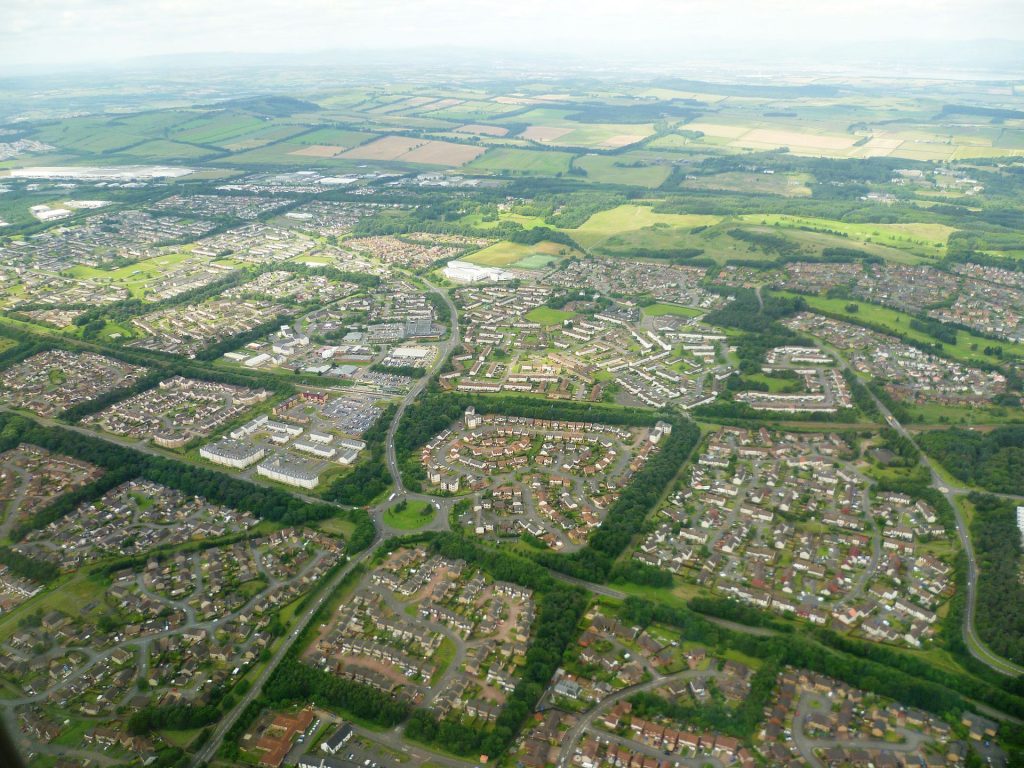
The need to make rapid progress with housing at a time of labour shortages meant that early housing at Livingston typically used prefabricated components including large concrete panels. Known as the Jespersen system, the result was a very distinctive – sometimes rather stark – environment. Growth was not as fast as had been predicted, by 12000 houses had been built by 1980 and Livingston had become the largest town in the Lothians after Edinburgh. A range of employers were attracted, including a major steel plant in the 1960s and, later, NEC electronics, part of a concerted effort to encourage scientific industry. By 1994, it was estimated that there were 980 employers and 24,500 jobs in the town.
Our project is now complete and you can read more about our findings in our Open Access book. You are still welcome to get in touch with Dr Alistair Fair via https://www.eca.ed.ac.uk/profile/dr-alistair-fair If you have any questions about the project or media requests.
See our Privacy Statement relating to comments here – https://newtownsscotland.eca.ed.ac.uk/privacy-cookies/