

‘Building a Modern Scotland: the New Towns, c. 1947-2017’ is a new project, funded by the Leverhulme Trust (July 2021-June 2023), which brings together researchers at the universities of Edinburgh and Glasgow. We’re interested in the architectural and social histories of the new towns begun in Scotland between the late 1940s and the early 1970s: East Kilbride, Glenrothes, Cumbernauld, Livingston, and Irvine. We’ll be looking at the original ideas for these new towns, and will then bring the story up to date by considering how people have made their lives in these places. We’ll also look at some of the proposals which never made it off the drawing board, such as the abandoned plans for a new town at Stonehouse.
Although many Scottish towns and cities changed dramatically during the second half of the twentieth century, our focus on the ‘new towns’ reflects the distinctive status of these places. They were the products of government policy, which after 1945 sought to reduce overcrowding in Glasgow and to attract new industries to Scotland through a process of ‘decentralisation’. The new towns would provide spacious new housing and sites for industry, in a comprehensively planned way. Unlike other new communities (such as Erskine or Dalgety Bay), which were created by local councils or private enterprise, the new towns were the results of government order. They were planned and built by semi-autonomous ‘Development Corporations’ which existed outwith the usual structures of elected local government.
The aims were as much social as architectural. In addition to much talk of better housing and space for industry, planners and policymakers believed that the new towns would bring a beneficial new way of life to those who lived there. The aim was very much a ‘modern Scotland’: architecturally, economically, and socially. For some, this ambition was problematic: was it right, for example, to reduce the population of Glasgow as much as eventually happened?
We’re interested in the ideas behind each of the new towns. For example, how did their plans take account of changing patterns of family life, or increasing levels of car ownership? What assumptions were made about class, gender, and ethnicity? What did planners imagine that residents would do in their leisure time, and how did they try to accommodate that? How did ideas of ‘community’ shape the new towns? We’ll also situate these new towns in their wider contexts, looking at how developments in Scotland compare with England, Wales, Northern Ireland and beyond.
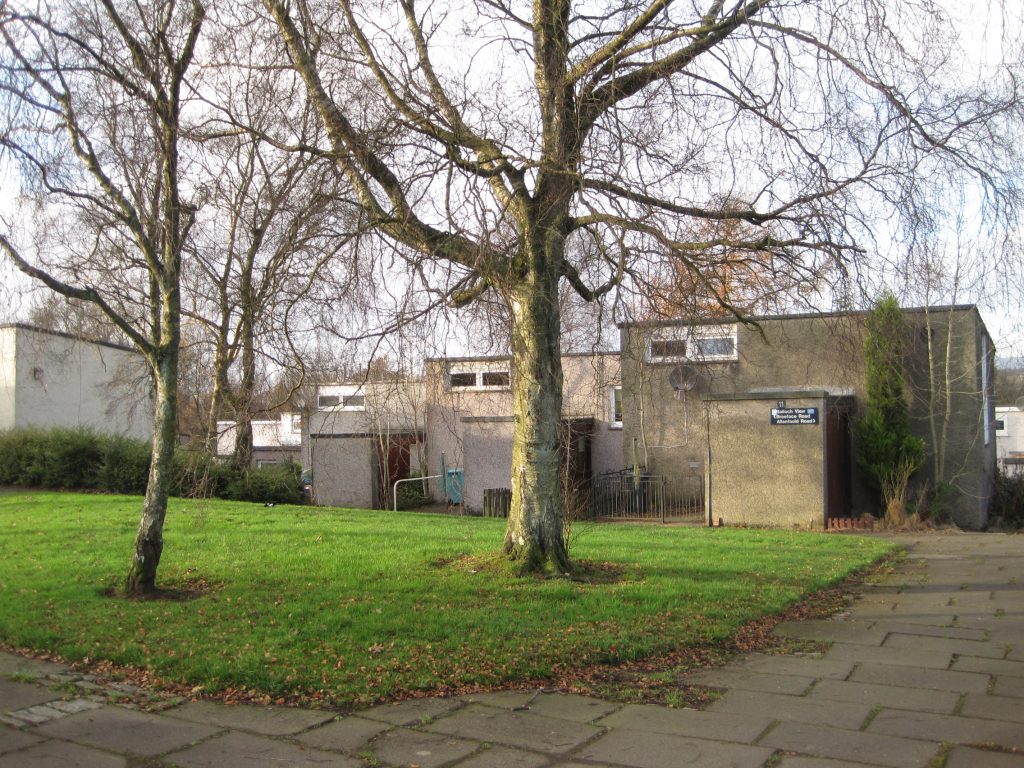
Our work on the ‘architectural’ side of the story will use material in local and national archive collections. The status of the new towns means that their creation was extensively documented at the time. To understand how people lived in the new towns, and what they thought of these places, we’ll mix archive work with oral history interviews.
Our team brings together researchers with complementary expertise. Professor Miles Glendinning has worked extensively on twentieth-century Scottish architecture. Professor Lynn Abrams and Dr Valerie Wright are social historians whose work includes studies of East Kilbride new town and the experience of high-rise housing in post-war Glasgow. Dr Alistair Fair is a historian of twentieth-century architecture and planning whose work looks at Scotland and the wider UK. Dr Kat Breen has researched post-war housing in Fife, while Dr Diane Watters is not only a much-published historian of post-war Scottish architecture but also, as someone brought up in Cumbernauld, brings a unique perspective to our work, which will lead to books and articles.
We’re very much aware that our work builds on previous studies of new towns, internationally, by historians, geographers, social scientists and others, and we look forward to engaging with their work, as well as wider studies of class, community and architecture in post-war Scotland and Britain. We’re also very keen to make contact with new town residents who might want to share their experience, as well as those whose work is inspired by the new towns, such as writers and artists.
Finally – why now? Scotland’s new towns are at a critical moment. Designed in the light of particular assumptions about modern life (and car ownership), our work will contribute to debates about the significance of these towns in twenty-first century Scotland. We’ll engage with questions of heritage (what should be protected?). And, with new towns and town extensions – such as Blindwells and Tornagrain – once more on the policy agenda, we hope also to contribute to the contemporary debate.
Keep an eye on this website for regular updates, including a monthly blogpost, as well as our Twitter feed @newtownscot [edit: social media no longer updated]
Alistair Fair
Our project is now complete but you are still welcome to get in touch with Dr Alistair Fair via https://www.eca.ed.ac.uk/profile/dr-alistair-fair If you have any questions about the project or media requests.
See our Privacy Statement relating to comments here – https://newtownsscotland.eca.ed.ac.uk/privacy-cookies/
I was born and brought up in Glenrothes (1962) and my father, now 99 (still with us) joined GDC in 1959 as chief estates manager – buying up the land for development of the town, encouraging new businesses etc. He left Glenrothes 10 years ago so has pretty much seen from near inception to present day. Would be happy to contribute/participate. Not sure he’d be in a position to just tweet comments but we’d accommodate some sort of questionnaire or interview if this is of interest to you.
Hi Lucile, thanks so much for posting – I’ll be in touch. Valerie
Quite interested by this. Was born in Glenrothes in 1960 in Rimbleton precinct. My.parents Helen and John Cairns – one of few young families who moved into what were for them, lively new dwellings. I have lived in the town since and seen so.many changes and developments.
Hi Roy, thanks so much for posting – I’ll be in touch. Valerie
Sorry… ‘lovely’ new dwellings…😊