
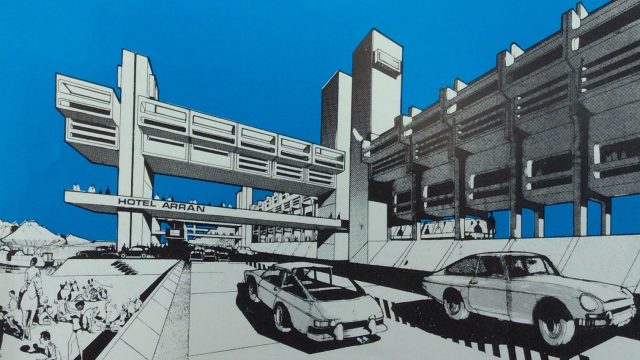
Irvine new town was designated in 1966. Located on the Ayrshire coast, the existing town was larger than the villages which formed the nuclei of the earlier Scottish new towns. Irvine’s intended role was understood in terms of economic development. It was already attracting new industrial and residential development: its designation as a new town was intended as a way to accelerate and co-ordinate these developments in the light of the 1966 White Paper on the Scottish economy, which had argued that Scotland needed to attract new industries and to build more high-quality houses.
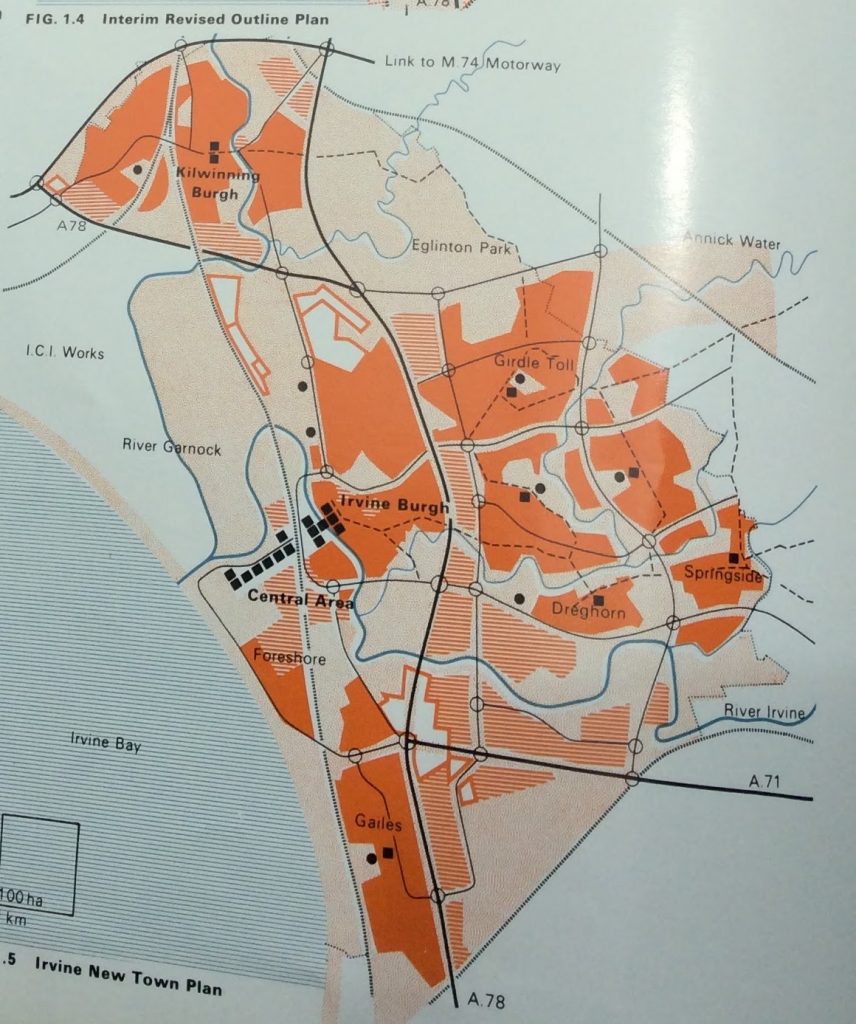
An initial masterplan was drawn up at the end of the 1960s by Hugh Wilson and Lewis Womersley. Wilson had previously overseen the initial stages of Cumbernauld and had since co-founded an independent consultancy which produced a number of new town masterplans. It proposed a linked series of communities parallel with the coast, with a new town centre to the east of the original town. These proposals proved impractical, however, owing to the presence of disused mine workings. A revised masterplan was drawn up in 1970 by a team led by the Development Corporation’s chief architect, David Gosling, moving the town centre into the heart of the existing town, part of which – including the town’s historic bridge – was to be cleared to make way for a new shopping centre (see map above and images below).
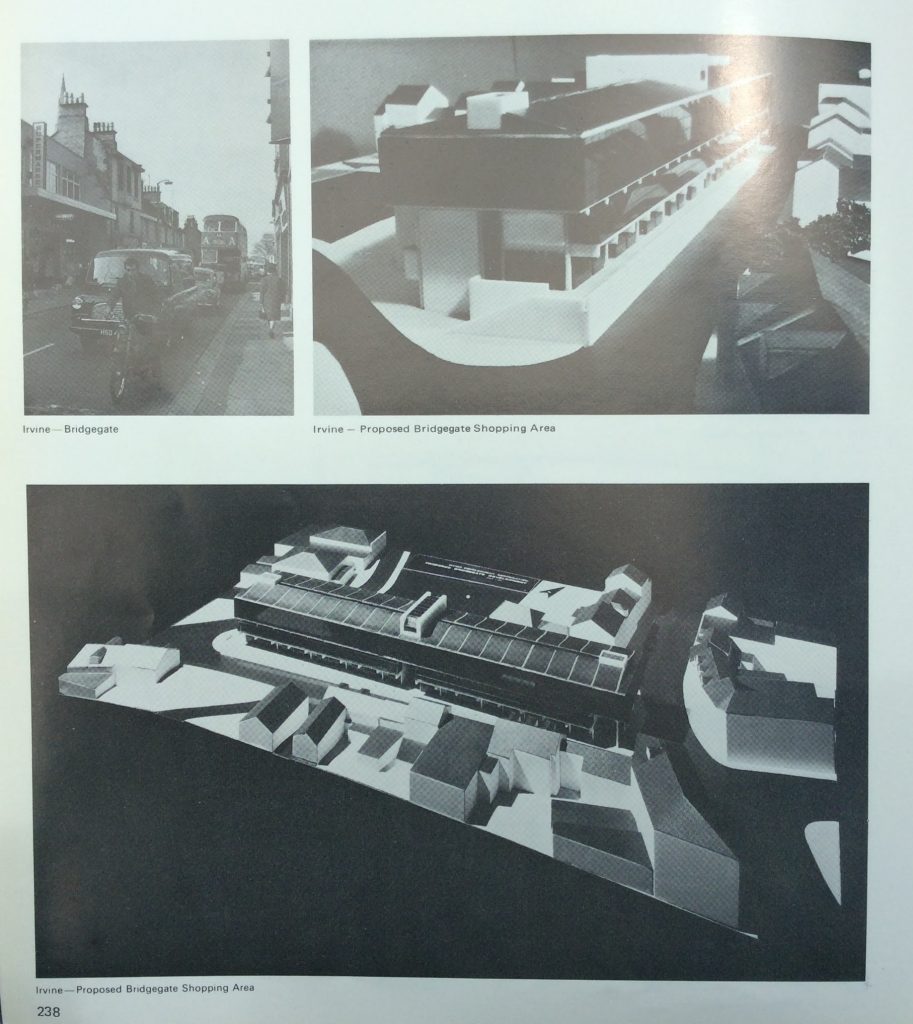
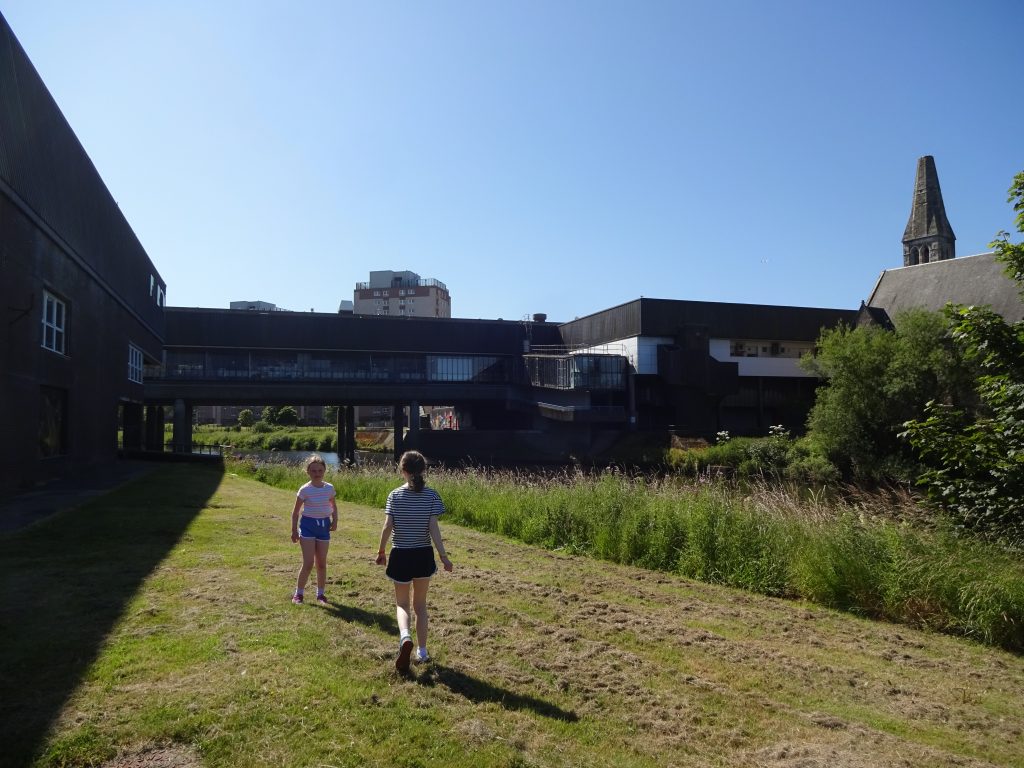
Irvine’s plan is distinctive for its ambition. The planners spoke of a chain of settlements stretching to Kilmarnock in the west and towards Glasgow in the north. These settlements would be linked by fast roads and also by ‘community routes’ (for public transport), creating a kind of polycentric town quite unlike the tight, compact focus of Cumbernauld and potentially accommodating well over 100,000 people. The planned shopping centre was similarly ambitious. It was to be part of a dramatic (and ultimately controversial) megastructure, stretching from the heart of the old town all the way to the coast, bridging across the river, roads, and a railway line as it went. At its end there was to be a large leisure centre (built as the Magnum Centre), the provision of which reflected growing interest among planners and policymakers in questions of recreation. The 1960s saw optimistic preductions that the working week would dramatically reduce in length by the year 2000; Irvine was thus conceived for a future age of structured leisure, centred on the harbour and a new marina. Also distinctive, compared with the earlier new towns, was growing emphasis on private-sector building and housing for owner-occupation, which was planned to comprise 25% of what was built.
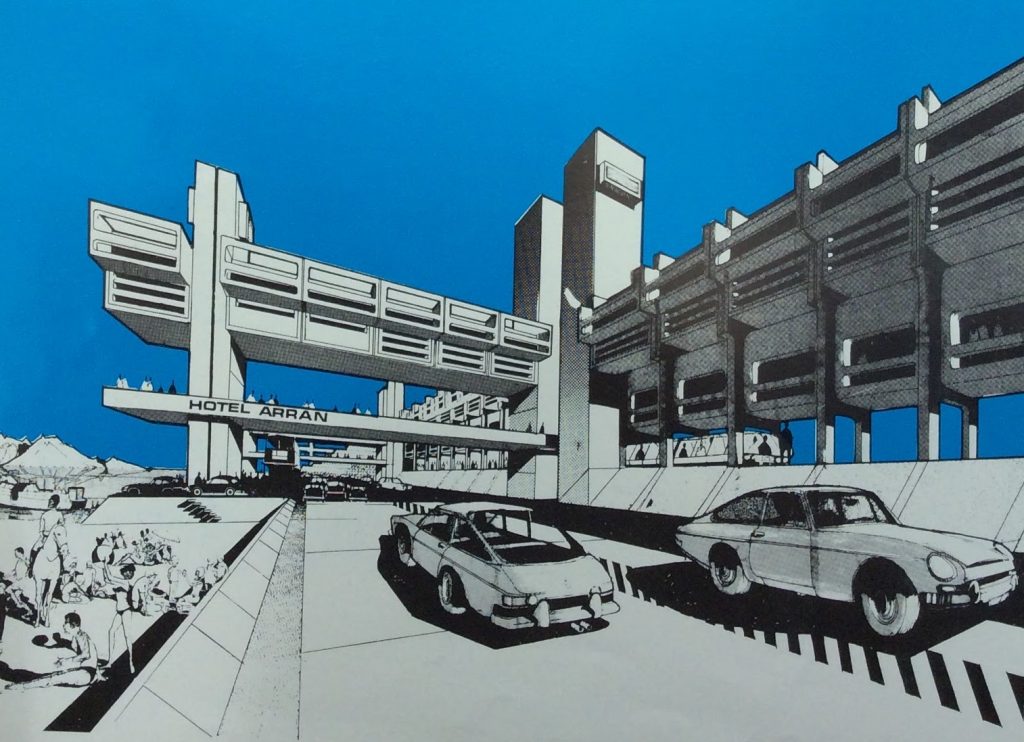
The plans for Irvine were published in a sumptuous illustrated book, which captures well the optimism and ambition of those who promoted it. Cutbacks in the 1970s, however, meant that the initial plans and population projections were scaled back. Nonetheless, parts of the new town centre were constructed as planned, as were significant areas of new housing at Bourtreehill and Broomlands. A distinctive style, a modern interpretation of the Scottish vernacular, was adopted in early housing projects by the Development Corporation, with harled walls, windows with wide, dark-painted frames, and pitched slate roofs. By the 1990s, a distinctive and sophisticated ‘postmodern’ style, inspired by the likes of Charles Rennie Mackintosh, was evident in the Development Corporation’s work in the Harbourside area, which included conservation as well as new buildings. From the early 1980s, the Development Corporation’s role in providing new housing was more limited than previously, and the private sector assumed a growing significance.
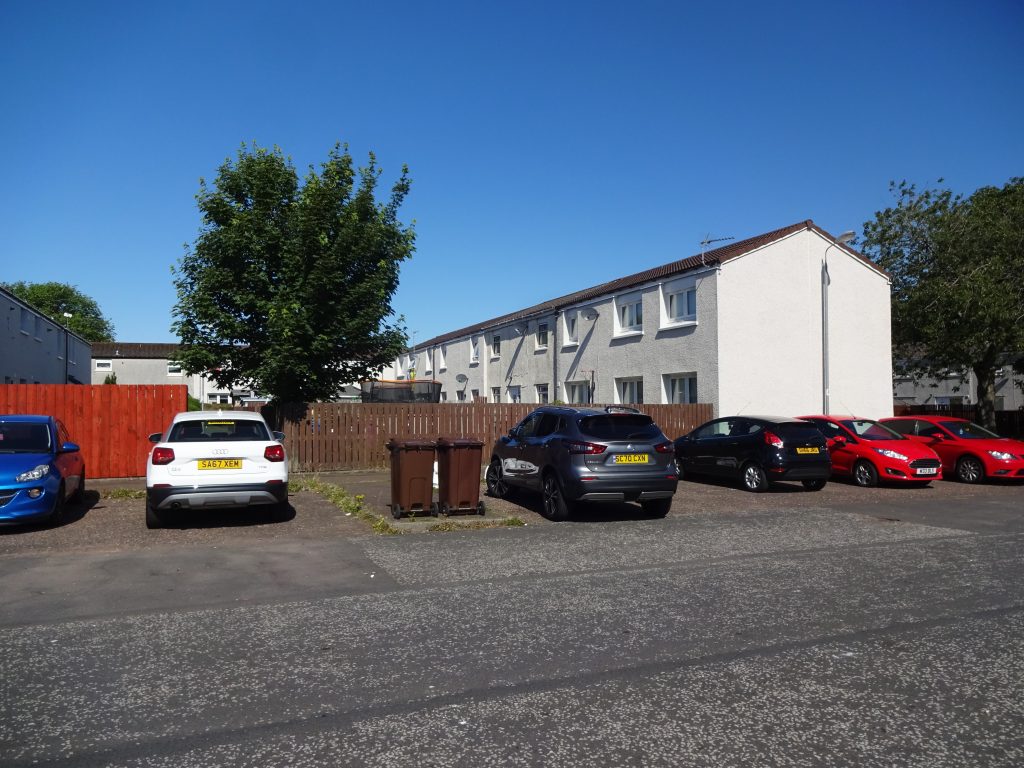
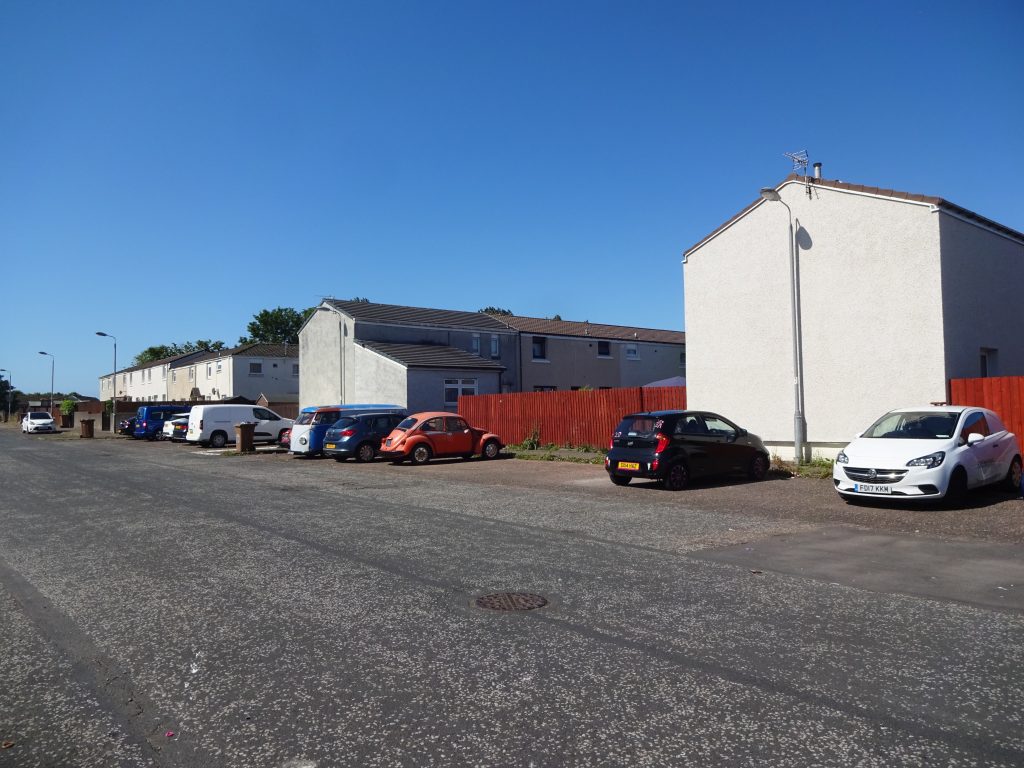
As an economic centre, Irvine’s fortunes were mixed. It had the misfortune to come to fruition as the Scottish economy stalled and manufacturing began to decline in the early 1970s, but nonetheless some key new employers came to the town. Without new town designation and subsequent investment, its fortunes could have been very different.
Our project is now complete and you can read more about our findings in our Open Access book. You are still welcome to get in touch with Dr Alistair Fair via https://www.eca.ed.ac.uk/profile/dr-alistair-fair If you have any questions about the project or media requests.
See our Privacy Statement relating to comments here – https://newtownsscotland.eca.ed.ac.uk/privacy-cookies/