

East Kilbride was designated as a new town in 1947, with a target population of 40,000. The village and surrounding area, to the south-east of Glasgow, had been identified as the potential location of a new town by the influential planner Patrick Abercrombie and his co-author, Robert Matthew, in the Clyde Valley Regional Plan, which was published after the Second World War. This major document set out a series of planning priorities for the area around Glasgow. The reduction of Glasgow’s population was thought to be the only way to remedy the severe overcrowding and poor housing conditions in many of the city’s inner areas: new towns would take some of this ‘overspill’. In addition to East Kilbride, new towns were proposed at Cumbernauld and Houston.

East Kilbride’s initial layout was devised by planners at the Department of Health for Scotland. It is typical of the first generation of post-war new towns in Scotland, Wales and England in that the town was conceived as a series of self-contained ‘neighbourhood units’, each focused on primary schools and shops. Main roads were arranged to go around the neighbourhoods, rather than through them, in the interests of pedestrian safety. Housing was laid out low densities, with a mixture of types of houses and flats: the aim was as much ‘social balance’ as it was a picturesque townscape. Industry was kept away from housing. A new town centre was planned, south of the old village. The first shops lined a new open thoroughfare, Princes Street, but subsequent phases adopted pedestrianisation and then took the form of enclosed shopping malls, making East Kilbride one of the largest shopping centres in Scotland by the end of the 1990s. Nearby the soaring concrete vaults of Dollan Baths provided some architectural drama.
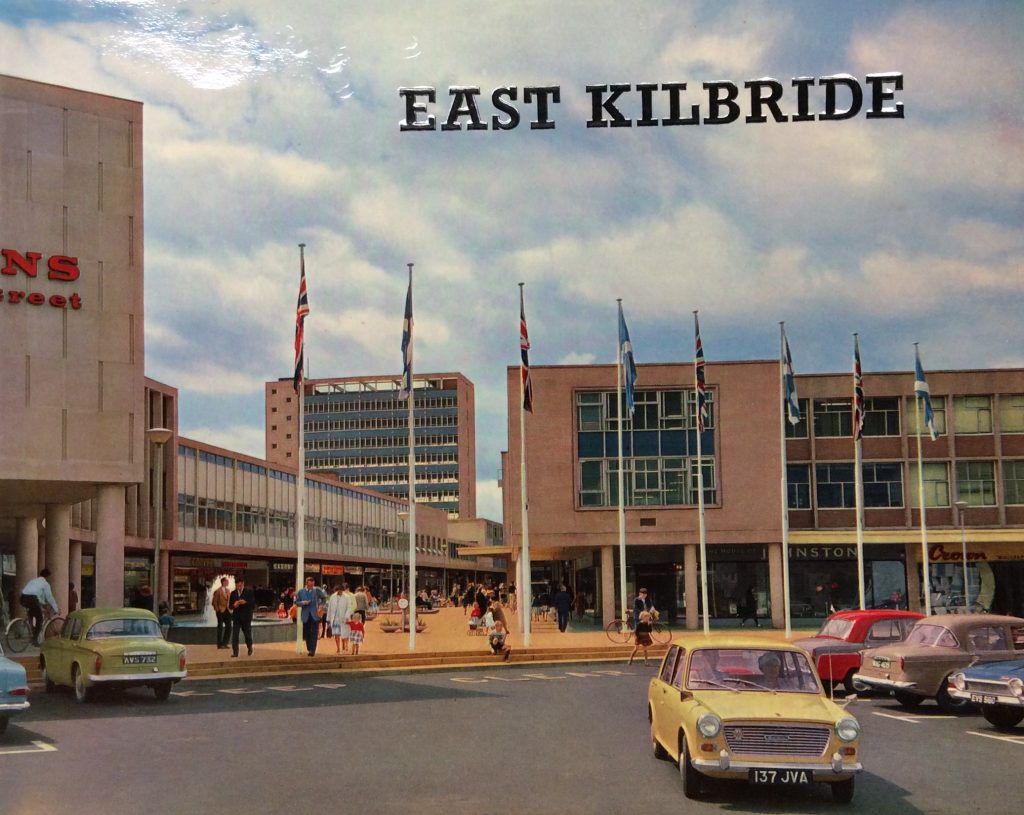

The population expanded rapidly, and the target was increased; by the 1990s, the population was around 70,000. Revised masterplans added further residential areas to the neighbourhoods planned in the 1940s. East Kilbride was very successful at attracting employers, with early arrivals including Rolls Royce, Imperial Chemical Industries (ICI), Schweppes, and Standard Telephone and Cable, as well as the government’s National Engineering Research Laboratory and then the Inland Revenue. Particular emphasis was laid on modern high-technology industry during the 1970s and 1980s. By 1995 the new town accommodated some 950 firms, providing 34,000 jobs in total. All this – and the high standard of housing – meant that East Kilbride had come to be known as one of the most successful new towns in Britain by the 1970s.
Our project is now complete and you can read more about our findings in our Open Access book. You are still welcome to get in touch with Dr Alistair Fair via https://www.eca.ed.ac.uk/profile/dr-alistair-fair If you have any questions about the project or media requests.
See our Privacy Statement relating to comments here – https://newtownsscotland.eca.ed.ac.uk/privacy-cookies/