
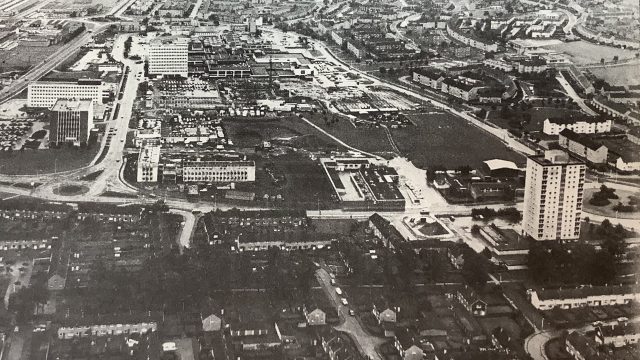
Designated in 1948, Glenrothes was the second of Scotland’s New Towns. The need for a New Town in the region was outlined in the 1948 Regional Survey and Plan for Central and South-East Scotland, by Frank Mears. In this plan, Mears highlighted the necessity for a New Town in the region to support the expanding mining industry in the area, with particular importance placed on the expansion of the new Rothes Colliery on the outskirts of the village of Thornton. An area of land just to the north of this was suggested, either side of the River Leven between Leslie and Markinch. This site benefited from its proximity to expanding mining areas, had sufficient space to house a large community, and was ideally placed to connect to the developing road and rail networks in the region. The initial plan for the site was to create a balanced community of 32,000 people, with an estimated one in eight of the population composed of miners. The aim was for this population to come largely from the west of the country, but many would also arrive from the surrounding region.
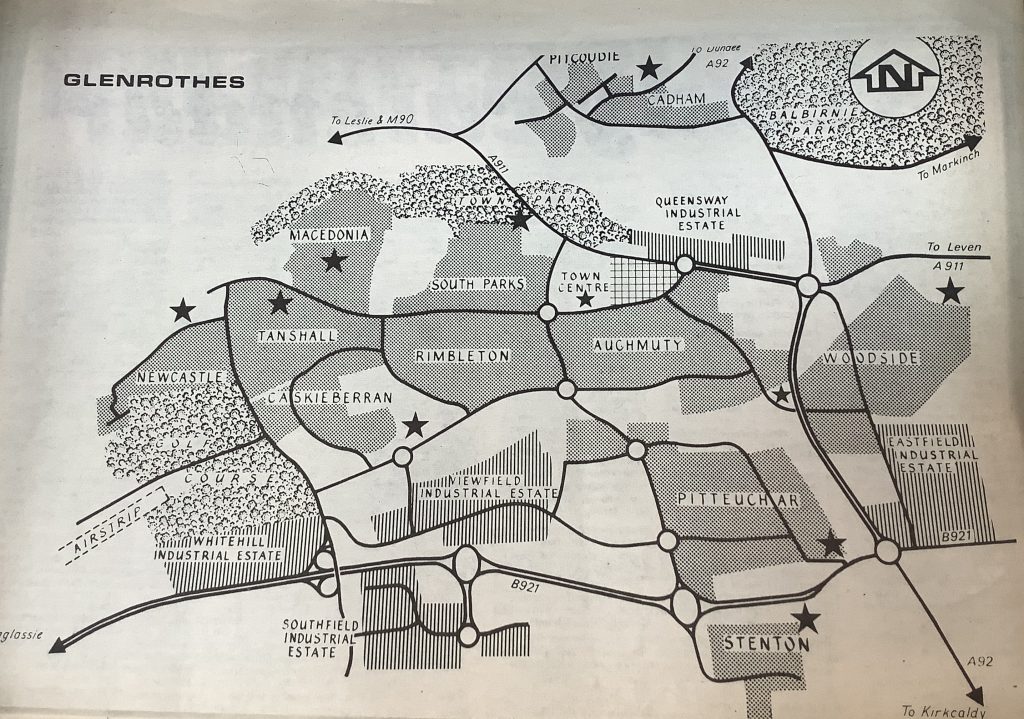
The first plan for the settlement was produced in 1951 by chief architect, Peter Tinto. Glenrothes was to be composed of a series of ‘precincts’ similar to the ‘neighbourhood units’ seen in other New Towns. These ‘precincts’ would include housing for a population of approximately 4,000 people each, and were intended to include around 1,200 homes, a primary school, cultural facilities, green spaces and in most cases, a small shopping area. A balance of housing types and standards would be provided in each area, allowing for a mixed population in terms of age and employment. These ‘precincts’ were to be dispersed around a pedestrianised town centre area, and separated by key access roads, green spaces and industrial estates. Although the town was originally designed so that the town centre could be accessed by a series of footpaths and underpasses, increased car ownership and the expansion of the town gradually resulted in the need for increased road access and parking spaces.
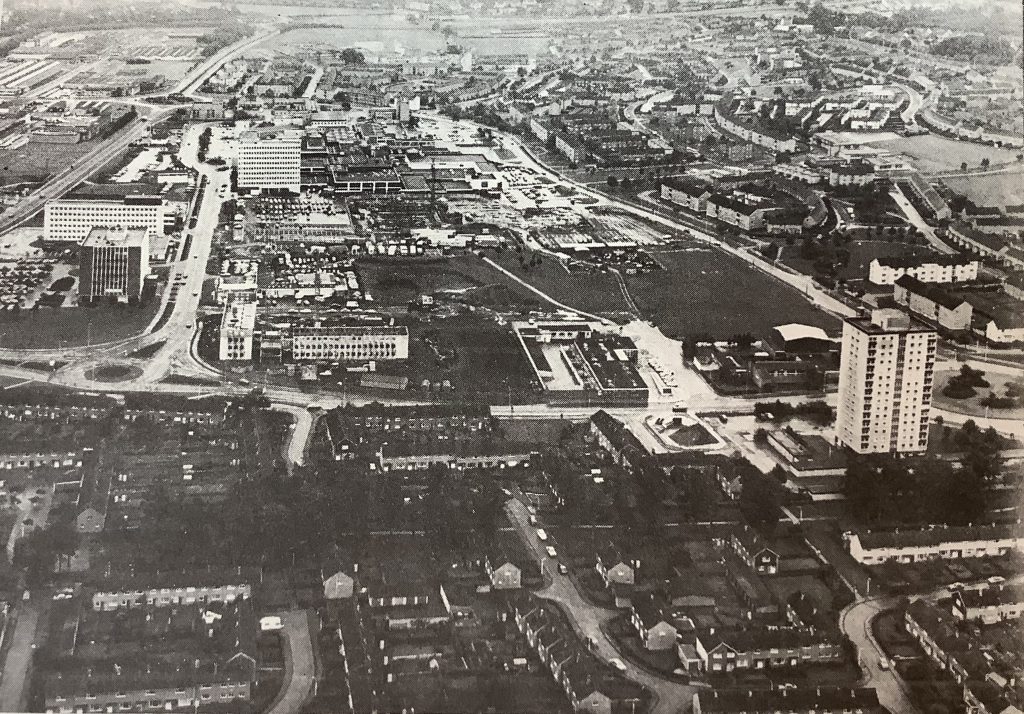
The population of Glenrothes was slow to expand, with the town failing to initially attract its projected population. The situation further worsened when it became clear that the new Rothes Colliery had experienced severe flooding and geological problems from the offset. Officially opened by HM Queen Elizabeth II in 1958, the mine was closed after just 5 years of production in 1962. This left hundreds of workers in Glenrothes unemployed and often forced to move elsewhere for work. In order to counter the loss the town’s key industry, the Development Corporation spent much of the 1950s and 1960s shifting their attentions from the mining industry to manufacturing, with particular focus on the electronics sector. By the late 1950s the first electronics factories had arrived in the town, and over the course of the following decades Glenrothes became an integral part of Scotland’s Silicon Glen, attracting electronics companies from around the globe. This success in attracting new industry helped Glenrothes to reach a population of around 40,000 by the time the Glenrothes Development Corporation was wound up in 1995.
Our project is now complete and you can read more about our findings in our Open Access book. You are still welcome to get in touch with Dr Alistair Fair via https://www.eca.ed.ac.uk/profile/dr-alistair-fair If you have any questions about the project or media requests.
See our Privacy Statement relating to comments here – https://newtownsscotland.eca.ed.ac.uk/privacy-cookies/