
Historians researching the recent past often employ oral history to access information and stories that don’t find their way into official records. The lived history of Scotland’s postwar new towns can only really be understood via people’s retrospective accounts of new town life set alongside public versions of that past. We have already trialled this methodology in two previous projects. Lynn Abrams and Linda Fleming first completed oral histories with the first generation of residents of East Kilbride in 2011. Lynn and I later returned to East Kilbride while completing a project on the experiences of living in high rise blocks in various locations in Glasgow in 2015 with our colleagues. On returning to the town we wanted to get a sense of why people had chosen to relocate to East Kilbride later in the 1970s and how their experiences compared to the earlier generation. Crucially we also wanted to speak to a younger generation – those that had grown up in the town.


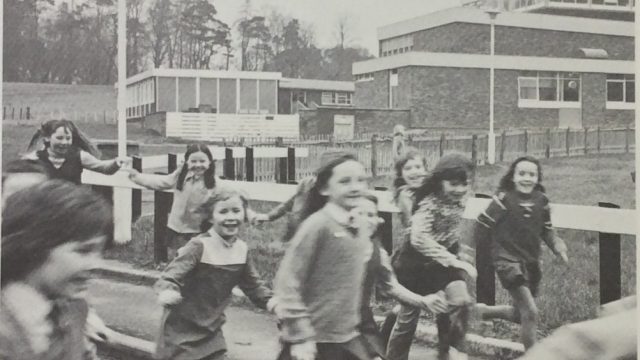
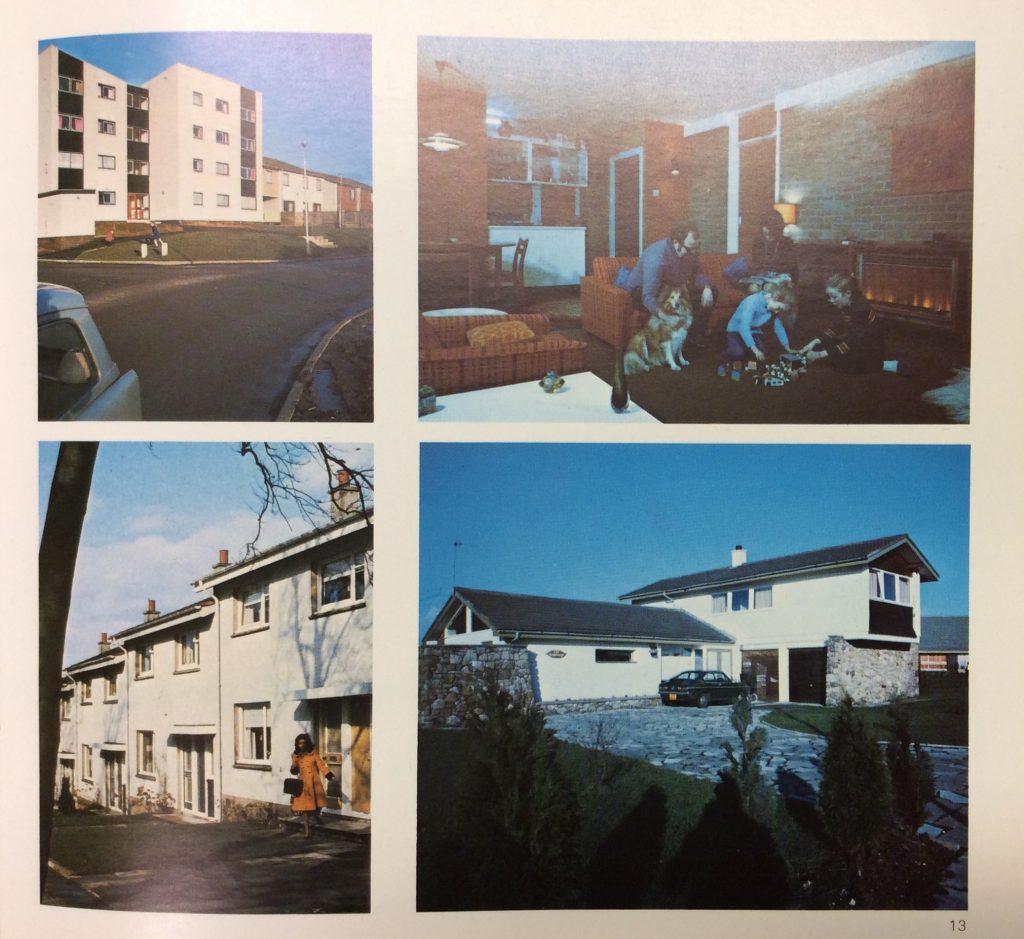
Images: children playing from ‘East Kilbride’, EKDC, c. 1973; ‘At Home in East Kilbride’ and ‘Primary School’ from ‘East Kilbride: Going to Town’, EKSDC, 1977.
The multigenerational approach was key to our project. It had been difficult to find people to interview from the generation that had first moved into high rise in Glasgow in the late 1960s in our case study locations. Yet, we were fortunate to be able to speak to those who had grown up in high rise as children or had moved to high rise as adults at a later date.
We wanted to compare the experiences of those growing up in high rise in Glasgow and in low rise housing in a new town. East Kilbride was the obvious choice as it was geographically very close to one of our case studies – Castlemilk on the South East periphery of Glasgow. The peripheral housing estates in Glasgow built by the Corporation of Glasgow focused on housing first and few amenities were provided for residents. It took years for the Corporation to build a shopping centre, schools and community centres. The experience was very different in East Kilbride with such amenities being a priority for planners. The other crucial difference was that all the new towns were key to the diversification of industry in Scotland and were built to attract new industries and investment. Theoretically those moving to East Kilbride would be able to work in the town and would not have to commute back into Glasgow for work.
Therefore, we wanted to see how the experiences of living in these two places compared and especially how the younger generation reflected on their childhoods and adolescence, their ambitions and aspirations for the future. We conducted a small number of interviews in East Kilbride which captured the motivations for those relocating to the new town as well as the experiences of growing up in the town. This included one intergenerational interview with a father and son – Ronnie and Graham
These interviews highlighted the sacrifices made by the older generation in moving to the new town but also the ways in which families were able to fulfil their ambitions and aspirations and ‘remake’ themselves in their new communities and neighbourhoods. Ronnie was well aware of the opportunities offered by East Kilbride when commuting to work in the town prior to getting married:
‘Every house I went to . . . walking about and by the front door a wee bit of grass, lovely smell and fresh air, quite high up. I said to myself, if I ever get married, I’m gonna come down here to live. A lot cleaner and a lot fresher. A brand new start for people coming out here’.
For all that those moving to East Kilbride had left behind in Glasgow, over time they settled in, made friends and gained a sense of belonging. For this older generation their children were often one of the main motivations for relocating – they wanted to give their children opportunities that they themselves had not had. This could be anything from their own garden to play in, ‘fresh air’ and generally what they hoped would be a better standard of living. The move was seen as an investment in their children’s future.
How did this turn out for those who had grown up in East Kilbride? These extracts tell us a just a little bit about the experience of childhood and adolescence and how views on the town changed over time. Graham was very positive about the opportunities the new town offered him:
I feel an affinity with it because I grew up there, and I have a lot of good experiences. I’ve worked and lived in other places, yeah… I think I can appreciate growing up in a place that my dad moved our family to that was open, new, clean, had fresh air in it. Didn’t have any big factories […]. Many amenities. A sort of feeling of, this might sound a bit corny, but when you move out to a place like that, your sort of approach to life feels like one where you’re gonna… it felt aspirational, it really did. I don’t mean that in a corny way. That’s what I felt. We could do things, there was opportunity. Maybe that’s the better word. There was opportunities. All that felt positive to me.
But Nicky, whose parents also moved from Glasgow, had a less rosy memory:
[…] But I remember the singer said the only thing you can do in East Kilbride is just take drugs, cause it’s that bad. And we totally… we were really into the Mary Chain. We were like… we get this man. East Kilbride is shit, man. There’s nothing to do. All the exciting things were happening in Glasgow. East Kilbride was… nothing happened in East Kilbride, you went to the crap discos where they played crap music, and you know. You got a bottle of Thunderbird and got leathered before you’re even out and then woke up in the forest outside the Dollan Baths at 2 in the morning.
The varying opinions of childhood friends Graham and Nicky highlight the value of oral history. East Kilbride and the new towns in Scotland, like most places, are often popularly perceived to be one dimensional stereotypes by those who don’t know them. For example, East Kilbride is famous for its roundabouts and is sometimes referred to as ‘polo mint city’ by Glaswegians. But the history of East Kilbride is far more complex and nuanced than this nickname would suggest. Life in the town was as varied as the people who lived there. It still is. In the narratives we collected it was both an aspirational place for those who wanted more for their children and a town where nothing happened for teenagers who dreamed of the city their parents had left fifteen years or so earlier.
Our experience of interviewing more than one generation in East Kilbride has guided our approach to oral history in this project. We want to get a sense of how experiences of life in the new towns have changed through the generations by interviewing those who first moved to the town as well as their children and grandchildren.
We’re starting with Glenrothes, then moving on to Cumbernauld, Livingston and Irvine.
For more information see our ‘Oral History’ page here – https://newtownsscotland.eca.ed.ac.uk/get-involved/
Dr Valerie Wright
To find out more about our research on East Kilbride and for a taste of life in the town see :
Reports / Articles:
L. Abrams and L. Fleming, Long Term Experiences of Tenants in Social Housing in East Kilbride: an Oral History Study, 2011, Project Report. School of Humanities, Glasgow.
L. Abrams, B. Hazley, V. Wright and A. Kearns, Aspiration, agency and the production of new selves in a Scottish new town, c.1947-c.2016. 29:4, Twentieth Century British History, 2018, pp. 576–604. Also see http://eprints.gla.ac.uk/160414/
National Library of Scotland, Moving Image Archive:
‘Why Scotland: Why East Kilbride, 1972 – https://movingimage.nls.uk/film/0955
‘East Kilbride: Going to Town’ 1977 – https://movingimage.nls.uk/film/5782
Documentaries:
Nae Pasaran by Filipe Bustos Sierra – https://naepasaran.com
Images:
EK Modernism by Sylvia Grace Borda – http://www.sylviagborda.com/ek-modernism.html
EK Playlist:
Our project is now complete but you are still welcome to get in touch with Dr Alistair Fair via https://www.eca.ed.ac.uk/profile/dr-alistair-fair If you have any questions about the project or media requests.
See our Privacy Statement relating to comments and the contact form here – https://newtownsscotland.eca.ed.ac.uk/privacy-cookies/